The Pinned Paper Effect: Why Your Next Free Weekend Is Sellotaped to a Café Window
There is a particular kind of Saturday morning where the phone wins. You open it for the weather, drift into a feed, and surface forty minutes later with no plans and a vague sense of having been somewhere without going anywhere. Meanwhile, six feet from your coffee cup, a piece of A5 paper is doing quiet, old-fashioned cultural work: Thursday choir, all voices, first session free.
Welcome to the pinned paper effect. The best weekend plans in Britain are not always in an app, a newsletter or a ticketing site. Quite often they are stapled to a café window, Blu-Tacked beside the library door or curling gently on a board in the corner shop. They are free, local and slightly scruffy — and that is exactly why they are worth five minutes of your attention.
Start with the windows you already walk past
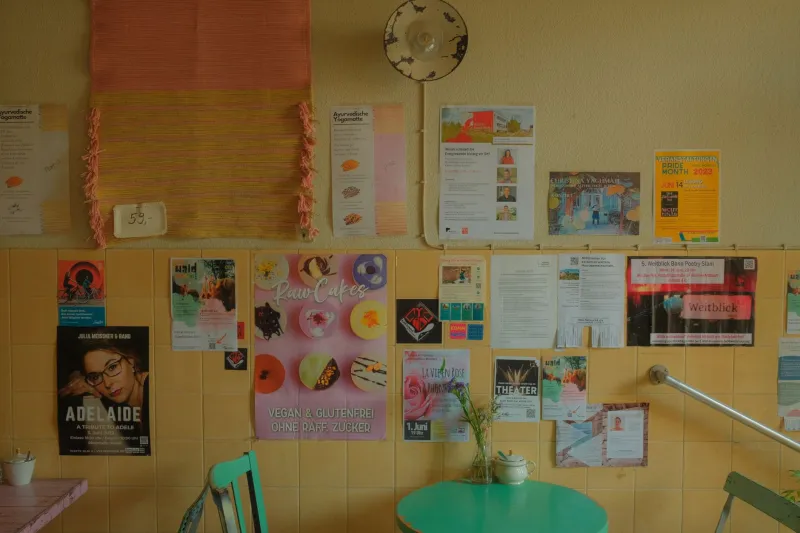
You do not need a special trip. Pick three noticeboards on your normal route: the café you like, the library, the church hall or the corner shop. Noticeboards are oddly democratic things. They hold the parish council diary, a lost cat, a ukulele group, a seed swap, a repair café, a yoga class in the scout hut and a request for volunteers to help at the autumn fair. They are edited by whoever has a spare drawing pin, which makes them the opposite of an algorithm.
Go at a relaxed time — mid-morning on a Saturday is ideal. Buy a coffee, stand near the board, and read it properly. Not a glance. A proper read. You are looking for dates, repetition and handwriting. A typed poster with a QR code is fine, but a handwritten card that says ‘Mondays, 7pm, upstairs — just turn up’ is the sort of thing that can change a whole month.
The five-minute safari method
Think of it as a small monthly ritual rather than a big lifestyle project. Once a month, give yourself five minutes at each board. Photograph two things that interest you. Circle one. That is the whole method. You are not signing up for a new personality; you are simply collecting local possibilities.
There are a few things worth scanning for. Look for recurring events rather than one-offs — a weekly club is easier to try than a single gala. Look for taster sessions and free first visits, which lower the stakes. Look for times that fit real life: a 7pm Thursday talk is more plausible than a 6am something-or-other in February. And look for small print about access: step-free entry, a hearing loop, a downstairs room, a bus stop nearby.
Ignore anything without a date, a time or a human name. Ignore the obvious pyramid-scheme flyers and the sad, sun-bleached posters from events that happened in 2024. Noticeboards have a natural compost layer; part of the pleasure is learning to read the fresh stuff on top.
What counts as a hidden gem
The best finds are usually the slightly unglamorous ones. A local history talk in the library. A monthly board-game evening in the back room of a pub. A clothes swap in the church hall. A gardening club that meets on the first Sunday and always has spare tomato seedlings. A choir that does not audition. A repair café where someone will look at your wobbly lamp while you drink tea from a mismatched mug.
These are not fringe activities. They are the actual texture of local culture, and they rarely spend money on promotion. A noticeboard is often the only place they advertise. That is what makes the five-minute safari feel like a small act of discovery rather than another consumer choice.
Turn paper into a plan — gently
Finding something is only half the trick. The other half is converting it into a plan before the poster fades. Take a photo, then put one event in your calendar while you are still standing there. Send the photo to a friend with a simple message: ‘Fancy this?’ If it is free, make a note to buy a drink or a cake when you go — it keeps the venue alive and makes the whole thing feel less extractive.
Aim for one thing a month. Not five. One. A single choir taster, one repair café visit, one library talk. If you enjoy it, go again. If you do not, you have lost an hour and gained a story. The habit works because it is low-commitment and local, not because it turns your weekends into a festival programme.
Why it beats an hour of scrolling
Feeds are designed to keep you looking; noticeboards are designed to get you out. A feed shows you what is popular, promoted or nearby in a database. A board shows you what somebody in your actual neighbourhood could be bothered to print, pin and update. It is human-scale curation. It is also finite. When you reach the bottom of the board, you are done. That is a surprisingly rare feeling in 2026.
There is a social bonus, too. Café staff often know which club is friendly, which room is cold and which talk is worth your evening. Ask. You will learn more in two minutes at the counter than in twenty minutes of searching. And the next time you walk past, the board will look different — a new poster, a changed date, a handwritten note — which is its own small reminder that the world beyond the screen is still ticking along.
The board as a mirror
A noticeboard tells you what a place cares about: its allotments, its toddlers, its old cinema, its refugees, its quiz nights, its lost cats. Reading it is a quiet way of paying attention to where you live. You do not have to join everything. You just have to look.
So next weekend, before the scroll begins, give the café window five minutes. Photograph two things. Circle one. Let the pinned paper do what it has always done: turn a vague Saturday into somewhere to go.